
Reverse osmosis vs whole house water filter in Miami: clean showers and pure drinking water
Updated November 22, 2026
Reverse osmosis vs whole house water filter is rarely either-or in Miami: we install catalytic carbon on the main line for clean, odor-free water at every shower and sink, and NSF/ANSI 58 reverse osmosis at the kitchen sink for pure drinking water, both in one visit with one permit.
- Free in-home water test
- Written quote, no pressure
- Licensed, insured installers
- Free in-home water test
- Licensed, insured installers
- Permits handled for you
- We service what we install
Reverse osmosis or a whole house water filter: which does a Miami home need?
A house on Miami-Dade water needs both, because each one fixes a problem the other can’t reach. Think of it as two jobs in two places.
Job one is every tap. The county keeps chloramine in the pipes, and you notice it in the shower steam, the bath and on dry skin and hair. The byproducts disinfection leaves behind come along with it. Only a system on the main line, before the water heater, treats the water at every fixture. That’s a whole house water filter with catalytic carbon.
Job two is the glass you drink. PFAS such as PFOS and PFOA are a drinking-water concern on county water, listed in the 2025 WASD report. Reverse osmosis certified under NSF/ANSI 58 for PFOA and PFOS is the system built for that, and it belongs at the faucet you fill glasses, pots and the coffee maker from.
A whole-house carbon tank alone leaves the PFAS question open. An under-sink RO unit alone leaves the shower smelling like a pool. Together they cover the house, and we install both in one visit with one permit.
How do reverse osmosis and a whole house water filter compare, check by check?
Carbon wins on coverage, RO wins on drinking water. Here are fourteen checks for a Miami home on county water.
| Check | Whole house filter (catalytic carbon) | Under-sink reverse osmosis |
|---|---|---|
| Where it goes | On the main line, ahead of the water heater | In the kitchen sink cabinet, with its own faucet |
| Water it treats | Every gallon entering the house | Drinking and cooking water at one faucet |
| Chloramine | Yes, the job it’s built for | At the drinking faucet only |
| Showers, baths and laundry | Yes | No |
| PFOS and PFOA | Only on carbon models certified for PFOA and PFOS; carbon results were inconsistent in a Duke study | Yes, on NSF/ANSI 58 models that list PFOA and PFOS |
| Trihalomethanes and haloacetic acids | Reduced at every tap | Reduced at the faucet |
| Lead from old faucets and fittings | Only on models certified for lead under NSF/ANSI 53 | Yes, on certified models |
| Nitrate and dissolved solids | No | Yes, on certified models |
| Scale on glass and the water heater | No; a softener or conditioner does that | No; it only lowers minerals at the faucet |
| Flow and pressure | Full flow when the tank is sized to the house | A smaller faucet fed from a storage tank |
| Water to the drain | Backwash on some tank models | Reject water while it makes drinking water |
| Certification we install to | NSF/ANSI 42 for chloramine; 53 for health claims | NSF/ANSI 58 for reverse osmosis |
| Works in a condo | Usually not; the association owns the main | Yes, it stays in your unit |
| What changes the price | Home size and flow, access to the main, the permit | Certified model, fridge or ice line, cabinet space |
A whole-house filter or softener counts as plumbing work under Florida law, and the county’s permit exemption list doesn’t exempt water treatment equipment. Our licensed, insured installers do the work and we pull the permit.
How does each system work on Miami water?
One adsorbs contaminants onto carbon as water flows through a tank; the other pushes water through a membrane fine enough to hold back dissolved chemicals.
A whole house water filter
A tall tank of catalytic carbon sits where the county line enters your house. As water passes through, the carbon breaks down chloramine and holds onto disinfection byproducts and the compounds behind the chemical taste. Catalytic carbon is the grade for chloramine, which is more stable than the plain chlorine older filters were designed for. Usually a sediment stage goes in front to protect the carbon. Every faucet, shower and appliance downstream gets the treated water, including the water heater. Read more on whole-house water filtration in Miami and on chloramine in Miami water.
Reverse osmosis
An RO unit takes cold water from the kitchen line, runs it through pre-filters, then forces it through a semi-permeable membrane. Molecules like PFOS, PFOA, lead and nitrate are held back and rinsed to the drain; the filtered water collects in a small tank that feeds a dedicated faucet. A Duke study reported by the Miami Herald found under-sink RO gave near-complete PFAS removal in testing, while activated carbon filters were inconsistent. That’s why we specify RO, not carbon, for PFAS. Details on reverse osmosis in Miami.
Clean showers from the main line, pure water from the kitchen tap
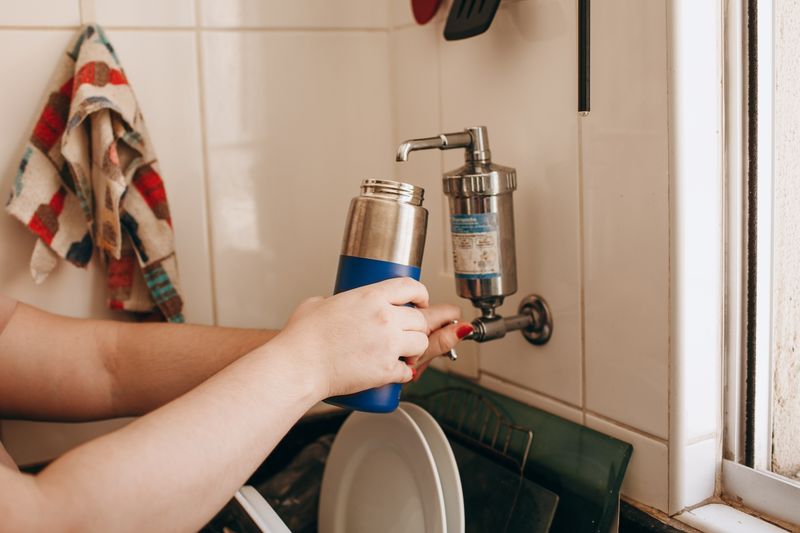
Bath time and showers get carbon-filtered water from the main line. Drinking, cooking and ice get RO water from the kitchen tap. One visit, one permit and one service schedule cover both.
Which one should you choose?
Most houses on county water need both; condos usually need RO. Most houses on county water fit the third column. Condos and renters usually fit the second.
Choose a whole house filter alone if
- The shower smell, dry skin and chemical taste are the complaints.
- You already have a certified RO unit under the sink.
- You own the house and the main line.
- You want treated water at the ice maker, kettle and washer too.
Choose reverse osmosis alone if
- You live in a condo or rent, and the association controls the main.
- PFAS in your drinking water is the main worry.
- You want to stop buying cases of bottled water.
- You want lead and nitrate filtered out at the kitchen tap.
Choose both if
- You own a house on Miami-Dade, Hollywood or Pembroke Pines water.
- You want the pool smell gone and PFAS out of your glass.
- You’d rather have one install, one permit and one service schedule.
- You want clean water for bath time and for every glass.
Scale is a separate decision. If your glass doors spot and the water heater crusts up, a softener or salt-free conditioner goes on the main line next to the carbon; see water softener installation. In a condo, our under-sink and condo filters pair RO with a shower filter instead of a tank.
What decides the price of RO, a whole house filter or both?
We quote it in writing after a free in-home test, and six things decide it: your home’s size, your water source, which stages you need, condo or house, the permit and your maintenance plan.
For a whole house filter, size matters most: more bathrooms means a bigger carbon tank, and the location of your main line sets the labor. For reverse osmosis, it’s the certified model, whether we tie in the fridge or ice maker, and how much room your sink cabinet has. Doing both in one visit saves a second trip, a second permit and a second set of fittings. Your written quote lists each stage and its price separately, so you can see what each one costs. Financing may be available; ask during your free test. See what decides your water filtration price.
What about whole-house reverse osmosis?
It’s the one system that handles both jobs, but on county water, carbon at the main plus RO at the sink covers the same ground for less.
Whole-house RO sends a share of every gallon to the drain as reject water, needs a large storage tank and a pump to bring pressure back up, and treats water you’ll only use to flush toilets and water plants. Where it can make sense is a private well with saltwater intrusion, where chloride and sodium need to come out of all the water. If that’s your situation, start with well water treatment.
How do we install both in one visit?
One visit covers the test, and a second covers the install of both systems, usually in about half a day. Tell us your ZIP and what’s bothering you, and a specialist calls you back, usually within one business day.
At the free in-home test we read hardness and pH at your tap, look at the main line, the pipe size and where the carbon tank can go, and open the sink cabinet to check room for the RO unit and its faucet. You get a written quote for the carbon, the RO and anything else the test shows. Then our licensed, insured installers set the carbon tank on the main, plumb the RO under the sink, pull the permit, and flush and check both before they leave. After that, we service what we install: carbon, pre-filters and the membrane on one schedule.
Not sure what else you need? Our guide to the best water filter for Miami ranks the options for houses, condos, wells and Broward homes.
What do Miami homeowners ask about RO and whole house filters?
Does a whole house filter take out PFAS?
Only a carbon model certified for PFOA and PFOS, and carbon gave inconsistent PFAS results in a Duke study the Miami Herald reported. Reverse osmosis gave near-complete removal in the same testing. That’s why we put certified RO at the kitchen sink and let the whole-house carbon handle chloramine. PFAS in Miami water.
Do I need RO if I already have a whole house filter?
On Miami-Dade water, yes, unless your whole-house system is certified for PFOA and PFOS by name. Many carbon tanks are sold for chlorine and chloramine only. We check the model and its listing during your free test, and add an RO unit under the sink if the PFAS stage is missing. Carbon filters and chloramine.
Which should I install first?
Install both at once if you can, since one visit and one permit cost less than two. If you need to stage it, start with the complaint that bothers you most: the shower smell points to whole-house carbon, worry about PFAS in your drinking water points to RO. We quote both so you can plan the second.
How long does installing both take?
Usually about half a day for both. Your water stays off only while the carbon tank is tied into the main, and we flush and check both systems before we leave.
Do you handle the permit?
Yes. A whole-house filter counts as plumbing work under Florida law, and Miami-Dade’s permit exemption list doesn’t include water treatment equipment, so we pull the permit as part of the job. Hollywood and other Broward cities permit separately, and we handle those too. Why homeowners choose us.
Where to next?
- Whole-house filtrationCatalytic carbon on the main line
- Reverse osmosisCertified RO under the kitchen sink
- Best water filter for MiamiRanked by type of home
- Chloramine in Miami waterWhy the shower smells like a pool
- Water filtration costWhat decides your price
- Service areasMiami-Dade and South Broward cities
Start enjoying clean showers and pure drinking water this week
Book a free in-home water test. We show you what is in your water, quote the right system in writing, and our licensed, insured installers handle the rest, permit included.